

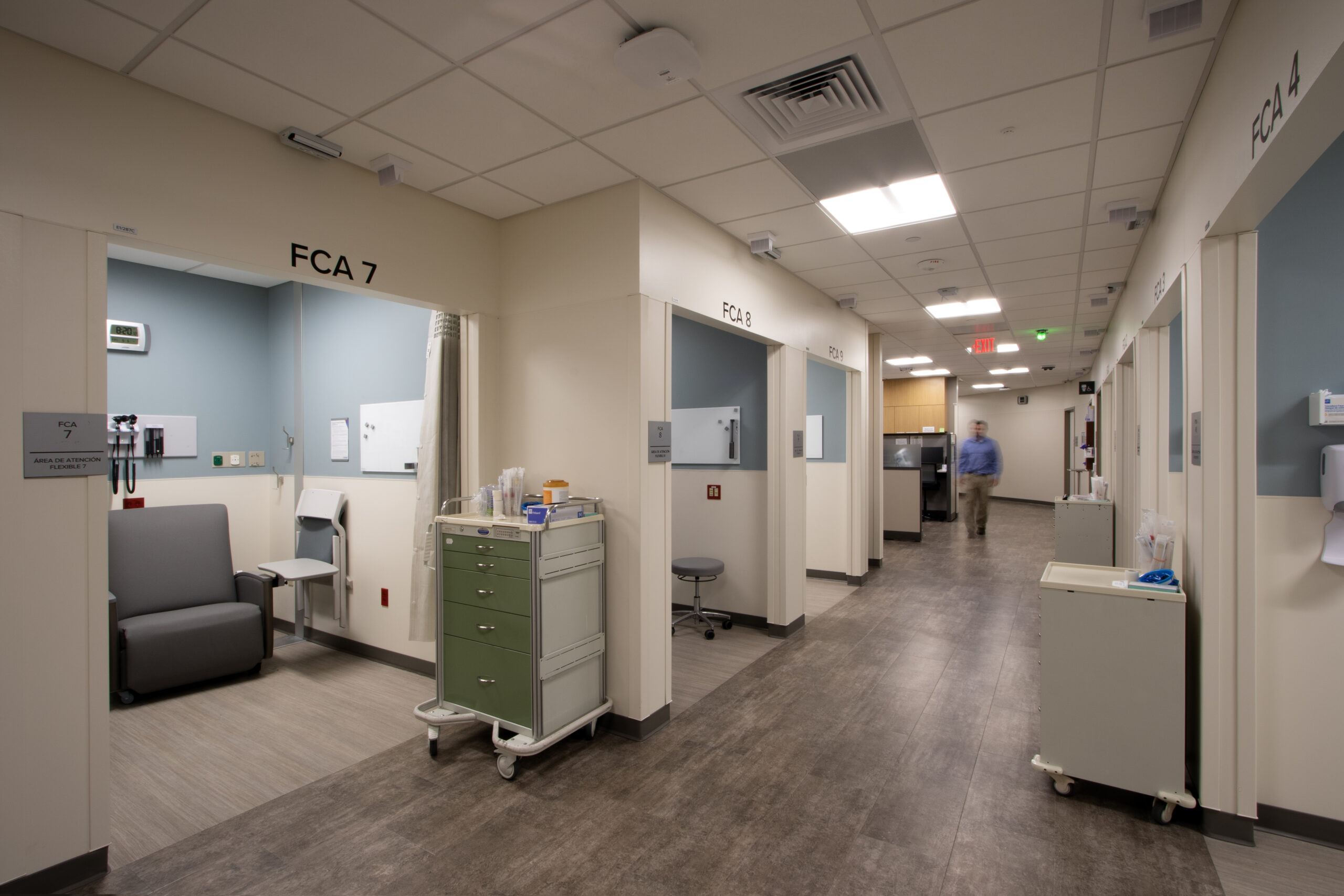
Hospital emergency departments continue to experience high patient volumes, which have been trending upward in recent years (Laglands). A new care model that hospitals can use to respond to increasing volumes is a Vertical Care Unit (VCU). In the VCU model, patients with lower acuity levels who have nonemergent complaints can be treated more quickly in a recliner and then discharged. This strategy frees up stretchers and exam rooms for more acutely ill patients.
Benefits of the Vertical Care Model
Vertical Care Units benefit the emergency department by providing a strategy to counter the high patient volumes by implementing different care tracks for patients with non-emergent needs. This results in the following main benefits:
Improved Throughput: The VCU expedites patient flow by allowing patients to be seen sooner, therefore increasing throughput. This model can also decrease waiting times, which leads to overall patient satisfaction. A decrease in waiting times also contributes to a reduction in the number of patients leaving without being seen (Evans).
Increased Capacity: By affording practitioners the ability to see more patients in a modality that is appropriate for their care needs, the VCU helps to keep exam rooms available for more acutely ill patients. Improving capacity and throughput can in turn reduce the number of ambulances diverted due to overcrowding (Evans).

Tips for Implementing a Vertical Care Unit
The VCU can be implemented in renovated spaces as well as new construction. The ability to utilize existing space within the hospital is particularly useful in existing healthcare facilities where square footage is at a premium and the option to expand the footprint may not be an option. Some questions to validate when planning a VCU are:
- Is this the appropriate location for the unit or should other areas be explored?
- How are workflows being maintained or are new staff workflows needed?
- Can the existing building support the structural load of the new unit?
- How does the VCU interface with the existing emergency department and adjacent units?
- Is there enough airflow capacity to handle the addition of a VCU?
A Safety Risk Assessment should also be conducted with staff, facilities, and security to determine appropriate safety measures within the VCU. Just as the emergency department needs to be protected from both internal and external risks, it is important that the VCU can be isolated from any threat that may be present in the emergency department.

Design Guidelines For Vertical Care Unit Spaces
The typical VCU consists of private treatment bays with chairs that can recline and even lie flat. Each treatment bay is outfitted with nurse call and code blue buttons as well as typical examination equipment. The Facility Guidelines Institute (FGI) defines the space requirements for a low acuity or Vertical Care space. Each patient care station should have a minimum clear floor area of 40 square feet with a minimum clear dimension of 5 feet 6 inches.
The patient care station must also include a minimum of 3 feet of clearance sat the side, head, or foot of the patient chair that corresponds with the care providers’ expected work position. Patients using wheelchairs or other mobility devices should also be considered when sizing low-acuity patient treatment areas.
A typical Vertical Care unit also provides staff and support spaces that allow the unit to be self-sufficient. Support spaces can include clean and soiled rooms, patient toilet rooms, staff work area, and medical equipment storage.

Providing Future Flexibility
Providing critical infrastructure to the unit upon its original construction, such as medical gas outlets, increases the treatment capability. While the outlets may not be used on a day-to-day basis, they provide more treatment capacity in the unfortunate circumstance of a mass casualty event. The VCU space would be capable of being used for triage and treatment of injured people in that scenario.
An additional way that a facility can plan for future flexibility is the size of treatment bays. A typical Vertical Care treatment bay is 40 SF at minimum. By providing a mix of larger bays that can accommodate stretchers, that allows for the treatment of patients who need to lay down or need more acute care. The larger treatment bay is another way that the unit can be planned for future flexibility without major space or infrastructure impacts.
The Vertical Care Unit model affords patients the ability to receive care in a way that more closely aligns with their needs while still being collocated in a space that allows for an increased level of care if needed. Vertical Care Units also allow staff to maintain a safe working environment as they are aware of patient needs and able to expedite patient flows. This care model improves the patient and staff experience while also improving capacity and throughput for the emergency department.
References:
Evans, Sherry. “What Works: An ED Goes Vertical to Improve Patient Flow and Satisfaction.” American Nurse, Sept. 2015, www.myamericannurse.com/works-ed-goes-vertical-improve-patient-flow-satisfaction/
Guidelines for Design and Construction of Hospitals. Facility Guidelines Institute, 2022.
Laglands, Bryan, et al. 2018, Facility Guidelines Institute: A Case for the Low-Acuity Patient Treatment Station,https://www.fgiguidelines.org/wp-content/uploads/2018/11/FGI-Low-Acuity-Patient-Treatment-Station_180126.pdf
View this article in Medical Construction & Design Magazine: Here